
GB/T Stainless Steel Flat Washers — 304 & 316
GB/T 97.1, GB/T 95 and GB/T 97.2 are the Chinese national standards covering the plain flat washer family — the same part shape as DIN 125 and ISO 7089, specified through a different standard body. We stamp all three at our Jiaxing factory in 304, 316 and 316L, to the nominal dimensions below. If your drawing carries a GB/T callout, this is the page that matches it; if you also need the DIN/ISO/ASME cross-reference, jump to the equivalence table below.
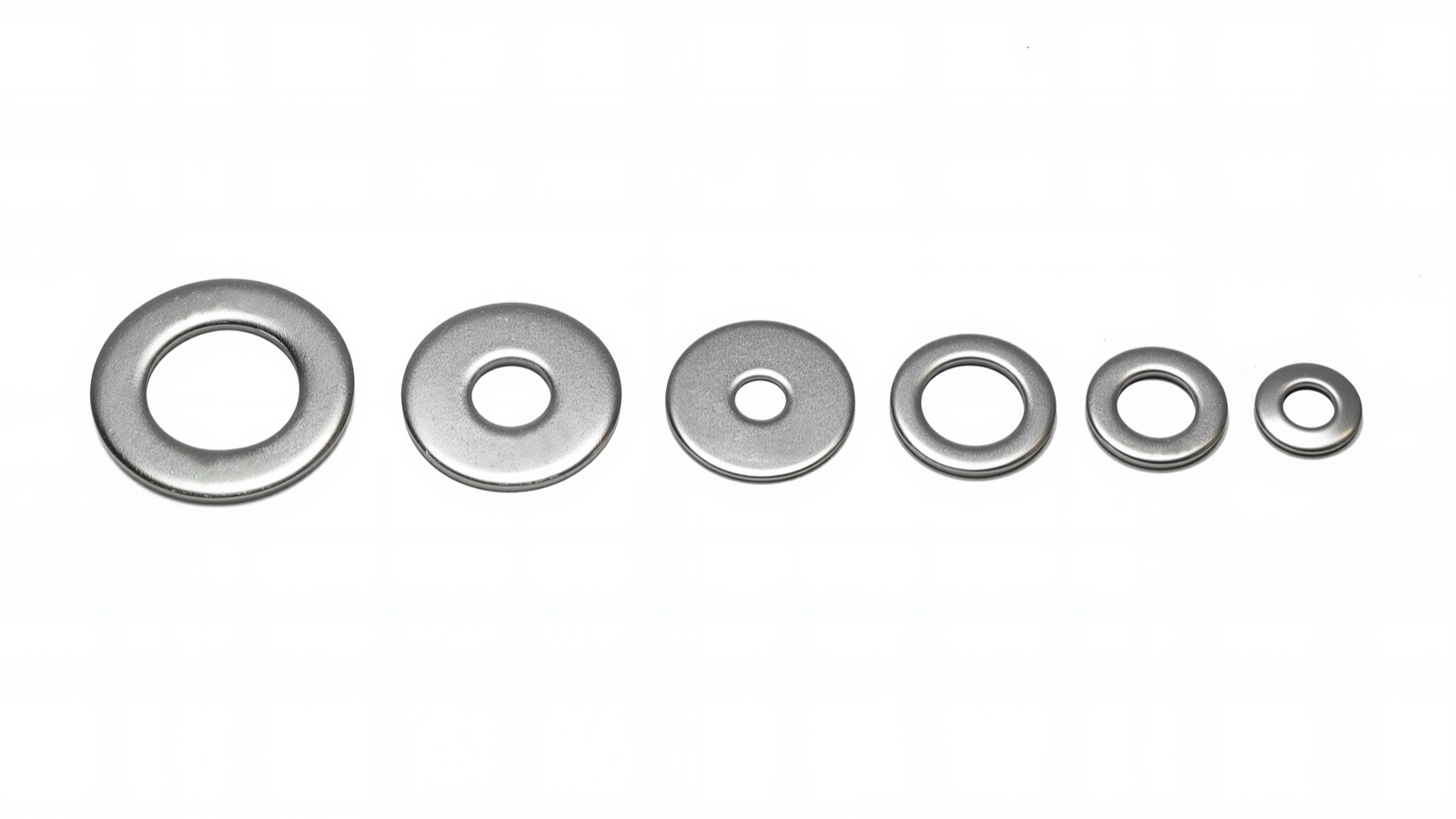
GB/T 97.1, GB/T 95, GB/T 97.2 — what each one covers
All three describe the same basic part — a flat, round washer — for the same thread size. GB/T 97.1 and GB/T 97.2 share the nominal dimensions; GB/T 95 has the same outer diameter and thickness but a larger bore. What changes between them is the tolerance grade and, for GB/T 97.2, a chamfer on one face.
GB/T 97.1
Plain flat washer, product grade A. This is the fine-tolerance version and the one most GB/T drawings mean by default. Equivalent to ISO 7089, with the same nominal dimensions. This is the standard we get asked for most often on GB/T orders.
GB/T 95
Plain flat washer, product grade C. Same outer diameter and thickness as GB/T 97.1 for a given size, but a larger bore (M8: 9 mm against 8.4 mm) and a coarser tolerance. Based on ISO 7091. Correct for general fastening where a tight fit is not required and cost matters.
GB/T 97.2
Same as GB/T 97.1 — product grade A tolerance — but with a chamfer machined or coined on one face. Based on ISO 7090. Specify it where the drawing calls for a chamfered bearing face, typically to seat against a fillet or a countersunk feature.
In practice: pick GB/T 97.1 unless your drawing specifically calls out coarse tolerance (GB/T 95) or a chamfer (GB/T 97.2). The size table covers GB/T 97.1 and GB/T 97.2; GB/T 95 is a coarser grade with a larger bore.
GB/T 97.1 dimensions (nominal mm)
Nominal dimensions for GB/T 97.1, equivalent to ISO 7089. All values in millimetres.
| Thread size | Inner Ø d1 (mm) | Outer Ø d2 (mm) | Thickness s (mm) |
|---|---|---|---|
| M2 | 2.2 | 5 | 0.3 |
| M2.5 | 2.7 | 6 | 0.5 |
| M3 | 3.2 | 7 | 0.5 |
| M4 | 4.3 | 9 | 0.8 |
| M5 | 5.3 | 10 | 1.0 |
| M6 | 6.4 | 12 | 1.6 |
| M8 | 8.4 | 16 | 1.6 |
| M10 | 10.5 | 20 | 2.0 |
| M12 | 13 | 24 | 2.5 |
| M14 | 15 | 28 | 2.5 |
| M16 | 17 | 30 | 3.0 |
| M20 | 21 | 37 | 3.0 |
| M24 | 25 | 44 | 4.0 |
| M30 | 31 | 56 | 4.0 |
| M36 | 37 | 66 | 5.0 |
Nominal per GB/T 97.1, equivalent to ISO 7089. GB/T 97.2 has the same dimensions plus a chamfer. GB/T 95 has the same outer diameter and thickness but a larger bore. Larger sizes available on request. Inch/ASME sizing is a separate system — see our DIN & ASME flat washers for that range. The ISO standards behind these GB/T numbers are covered on our ISO 7089, 7090 and 7091 stainless washer page.
GB/T, ISO and DIN — how they line up
Each GB/T standard was written to align with an ISO standard, and each ISO standard has a long-established DIN counterpart. The three columns below describe the same physical part.
| GB/T (China) | ISO | DIN (Germany) | Description |
|---|---|---|---|
| GB/T 97.1 | ISO 7089 | DIN 125 Form A | Plain, grade A (fine tolerance) |
| GB/T 95 | ISO 7091 | DIN 126 | Plain, grade C (coarse tolerance) |
| GB/T 97.2 | ISO 7090 | DIN 125 Form B | Chamfered, grade A |
Two more, for the adjacent large-OD and small-OD families: large outer diameter — GB/T 96 corresponds to DIN 9021 (fender washer). Small outer diameter — GB/T 848 corresponds to DIN 433. For the complete size-by-size cross-reference across GB/T, ISO, DIN and ASME/USS/SAE, see our full cross-reference guide .
Material: 304, 316 or 316L
Grade choice is set by the corrosion environment — not by surface finish or price alone. Here is the short version.
304 — the standard grade
18% chromium, 8% nickel. Good oxidation and general corrosion resistance. The right specification for indoor structural work, equipment assembly and most non-aggressive outdoor environments. Cost-effective and widely stocked.
316 & 316L — for chloride exposure
Adding 2–3% molybdenum gives substantially better resistance to chloride pitting and crevice corrosion. Specify 316 for marine, coastal, chemical-process and de-icing environments. 316L (low-carbon) is the right call for welded assemblies, where it resists sensitisation at the weld heat-affected zone.
We stamp to GB/T, ISO or DIN designation — same tooling
We produce GB/T 97.1, GB/T 95 and GB/T 97.2 in 304, 316 and 316L, either to the standard nominal sizes above or to your drawing. Tell us the designation on the PO — GB/T, ISO or DIN — and we stamp and mark accordingly; the tooling that makes an M8 GB/T 97.1 washer is the same tooling that makes an M8 DIN 125 washer, since the nominal dimensions match.
We verify the grade with our own handheld XRF spectrometer (PMI) and can include the reading with your order.
Quick facts
- Sizes M2–M36 standard, larger on request
- 304, 316, 316L stainless
- One finish: tumble-polished in sawdust; no plating or passivation
- ISO 9001:2015 certified factory, Jiaxing
- XRF grade check (PMI) on request
- FOB / CIF on request, HS 7318.22
GB/T washer questions, answered.
What buyers holding Chinese drawings usually ask us before ordering GB/T flat washers. Have one we have not covered? Ask our team.
What is GB/T 97.1?
GB/T 97.1 is the Chinese national standard for the plain flat washer, product grade A — the fine-tolerance general-purpose washer. It is equivalent to ISO 7089, so the nominal bore, outside diameter and thickness match ISO 7089 for each size. GB/T is the prefix used for Chinese national (recommended) standards; GB/T 97.1 is the one most buyers mean when they ask for a standard Chinese flat washer.
GB/T 97.1 vs DIN 125 — are they the same?
For the plain, un-chamfered washer, GB/T 97.1 and DIN 125 Form A carry the same nominal dimensions for a given thread size, because both match ISO 7089. An M8 washer to either standard fits the same bolt and bearing surface. They are separate documents — one Chinese, one German — but the physical part they describe is the same. We stamp to whichever designation your drawing calls for.
Difference between GB/T 97.1 and GB/T 95 (grade A vs C)?
The size table above is for GB/T 97.1 and GB/T 97.2. GB/T 95 has the same outer diameter and thickness but a larger bore. The other difference is tolerance grade: GB/T 97.1 is product grade A, the finer tolerance, equivalent to ISO 7089. GB/T 95 is product grade C, a coarser tolerance, based on ISO 7091. Grade C is cheaper to run in volume and suits general fastening; grade A is specified where a tighter, more consistent fit matters.
Do you supply to GB and DIN?
Yes. We stamp GB/T, ISO and DIN designations on the same tooling, in 304, 316 and 316L, to standard sizes or to your drawing. State the designation on the PO and we mark the labels to it. Most export customers specify DIN or ASME; most domestic and other-Asia customers specify GB/T directly — we handle both without re-tooling.
How do you verify the material grade?
We verify the grade with our own handheld XRF spectrometer (PMI) and can include the reading with your order. Send specs and quantity and we quote back within one business day. We cannot issue EN 10204 3.1 mill certificates.
Related pages
DIN 125 flat washers
The German-standard equivalent of GB/T 97.1, with the full M2–M64 size chart.
View DIN 125 pageFull standard cross-reference
GB/T, DIN, ISO and ASME/USS/SAE, size by size, in one table.
Open cross-referenceTell us what you need.
Send specs or a drawing and we will come back with pricing, lead time and material options. No account needed.
- ✓ 304 / 316 / 316L, GB/T 97.1 / 95 / 97.2 or custom
- ✓ Replies from our sales team, usually within one business day
- ✓ XRF grade check (PMI) on request
- ✓ FOB / CIF on request, HS 7318.22