
Stainless Steel Fender Washers
Oversized outer diameter to spread clamp load over soft, slotted or oversized holes. Produced in 304 and 316/316L stainless to DIN 9021 (ISO 7093 equivalent), plus custom outer diameters made to your drawing.
A wider footprint where the hole can't take a standard washer.
A fender washer is a flat washer with a deliberately oversized outer diameter — roughly three times the bolt nominal — and a relatively thin section. That extra bearing area is what makes it the part of choice when the hole is too large, slotted, soft or out-of-round for an ordinary flat washer to do its job.
By distributing clamp force over a much wider area, a fender washer protects sheet metal, composites, timber and plastics from being pulled through or deformed under the bolt head. We hold the dimensions to DIN 9021 (ISO 7093) and can step outside the standard for special outer diameters, inside diameters and thicknesses.
- Outer diameter ≈ 3× the bolt nominal — far larger than a DIN 125 flat washer
- Spreads load to prevent pull-through on thin or soft materials
- 304, 316 and 316L stainless; sawdust tumble-polished finish
- Standard M3–M24; custom OD, ID and thickness stamped to drawing
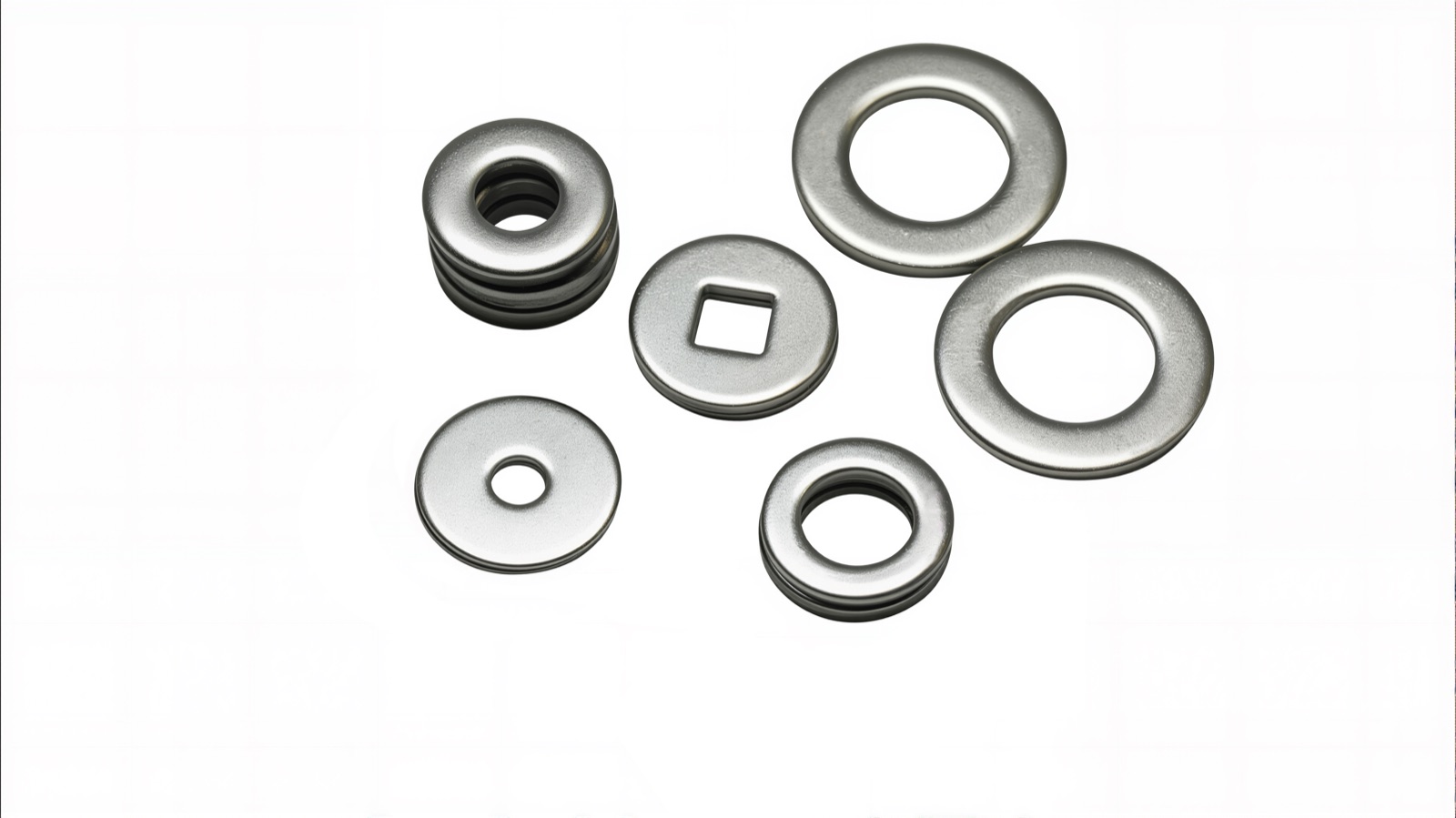
What makes a fender washer.
It is defined by proportion, not just size: a large outer diameter relative to the bore, in a thin flat section. That combination is what spreads the load.
Large outer diameter
The defining feature: an OD of roughly three times the bolt nominal — for example a ~24 mm OD on an M8. That wide rim is what bridges an oversized or slotted hole.
Thin, flat section
Relatively thin for its diameter — typically 0.8–5.0 mm across the M3–M24 range. Enough to bear load and protect the surface without adding bulk to the stack-up.
Load spread over area
The wide bearing surface distributes clamp force, preventing the bolt head or nut from pulling through soft sheet, composite, timber or plastic.
DIN 9021 large-OD fender washer dimensions.
Metric dimensions in millimetres, per DIN 9021 (ISO 7093 equivalent). The outer diameter is approximately three times the thread nominal. We verify the grade with our own handheld XRF spectrometer (PMI) and can include the reading with your order.
| Thread d | Inside dia d1 | Outside dia d2 | Thickness s |
|---|---|---|---|
| M3 | 3.2 | 9 | 0.8 |
| M4 | 4.3 | 12 | 1.0 |
| M5 | 5.3 | 15 | 1.2 |
| M6 | 6.4 | 18 | 1.6 |
| M8 | 8.4 | 24 | 2.0 |
| M10 | 10.5 | 30 | 2.5 |
| M12 | 13 | 37 | 3.0 |
| M14 | 15 | 44 | 3.0 |
| M16 | 17 | 50 | 3.0 |
| M20 | 22 | 60 | 4.0 |
| M24 | 26 | 72 | 5.0 |
We regularly stamp non-standard outer diameters, inside diameters and thicknesses to drawing. Send your specification and we will confirm feasibility and pricing — typically within ~1 business day.
Where fender washers earn their keep.
Anywhere the hole is larger, softer or more slotted than a standard flat washer can handle — and the joint still has to hold.
Sheet Metal
Bridges oversized or slotted holes in thin gauge, spreading load to prevent pull-through.
Automotive Body
The original "fender" use — securing body panels and brackets over enlarged or rusted holes.
Marine
Corrosion-resistant 316 fender washers for hull fittings, decking and exposed hardware.
Signage
Mounting panels, channel letters and fascia where wide bearing protects soft or thin substrates.
Solar PV
Module mounting and clamping where outdoor exposure demands a corrosion-grade, load-spreading washer.
General Assembly
Plastics, composites and timber fastening that needs a large, smooth bearing face.
Grade and finish, matched to the environment.
Fender washers spend their life on the surface of a joint, often outdoors — so material and finish matter as much as dimensions.
304 — general duty
Strong general corrosion resistance for indoor, structural, automotive-body and most architectural fastening. The cost-effective default for sheet metal and signage.
- Sheet metal, automotive body, signage, general assembly
316 — marine & coastal
Added molybdenum for chloride and sea-spray resistance. The grade to specify for marine hardware, coastal solar and any wash-down or weather-exposed mounting.
- Marine, coastal solar, chemical, exposed outdoor
Finish
Plain stainless, tumble-polished in sawdust (wood chips) after stamping — the only finish we supply.
No coatings
We do not plate, coat or passivate. For coastal or wet locations, choose 316 / 316L — the grade, not a coating, sets corrosion resistance.
Documentation
We verify the grade with our own handheld XRF spectrometer (PMI) and can include the reading with your order. We cannot issue EN 10204 3.1 mill certificates.
Fender washer questions, answered.
What is the difference between a fender washer and a flat washer?
A fender washer has a much larger outer diameter for its bore — typically about three times the bolt nominal — while a standard flat washer (DIN 125) has an OD only slightly larger than the hole. The oversized OD lets a fender washer bridge soft, slotted or oversized holes and spread clamp load over a far wider bearing area. Fender washers are also relatively thin for their diameter.
What sizes and outer-diameter options are available?
We produce DIN 9021 / ISO 7093 fender washers from M3 to M24 as standard, with outer diameters from 9 mm to 72 mm and thicknesses from 0.8 mm to 5.0 mm. The outer diameter is roughly three times the bolt nominal. Custom outer diameters are made to drawing; the dimension table above shows representative sizes.
Can you make custom outer diameters?
Yes. We stamp special outer diameters, inside diameters and thicknesses to your drawing or sample in 304, 316 or 316L stainless, with first-article inspection before the run. MOQ for non-standard items is 100 kg per item. Send a print or sample and we will confirm feasibility and pricing.
Do your fender washers conform to DIN 9021?
Yes. Our standard large-OD washers are produced to DIN 9021 (ISO 7093 equivalent), with an outer diameter approximately three times the bolt nominal. Dimensions and tolerances are held to the standard across the M3–M24 range. We run high-speed coil-fed JH21-series presses with tight process controls, so dimensional consistency across a production batch is not dependent on manual handling. If you need sizes outside the DIN 9021 table — larger ODs, finer bore tolerances, or non-standard thicknesses — those are quoted to drawing.
Are fender washers available in both 304 and 316 / 316L stainless?
Both grades are standard. 304 (A2) covers most indoor, structural and general outdoor uses. 316 and 316L (A4) are the usual choice for seawater, marine and coastal use, with higher corrosion resistance than 304. All material is stamped to full thickness; we do not use under-gauge or recycled substitute coil. We check the grade of finished parts with our own XRF spectrometer (PMI).
How do you document the material grade?
We check the grade with our own handheld XRF spectrometer (PMI) and can include the reading with your order. We cannot issue EN 10204 3.1 mill certificates. Our quality management system is certified to ISO 9001:2015 (cert. 74326Q00174R001), with first-article inspection on custom parts.
Tell us what you need.
Send specs or a drawing and we will come back with pricing, lead time and material options. No account needed.
- ✓ 304 / 316 / 316L, DIN & ASME or custom
- ✓ Replies from our sales team, usually within one business day
- ✓ Samples on request, courier freight paid by the buyer