
Stainless Steel Flat Washers
General-purpose flat washers in 304, 316 and 316L stainless — produced to DIN 125 and ASME / USS / SAE standards, across the full M2–M64 range, plus non-standard sizes and finishes stamped to your drawing.
The simplest part in the joint — and one of the most important.
A flat washer sits between the fastener head or nut and the work surface to do three jobs at once. It is the quiet detail that decides whether a bolted joint holds clamp load over its life.
- Distributes load. It spreads the clamping force over a larger area, reducing the stress concentration directly under the bolt head or nut.
- Protects the surface. It guards the mating face against scoring, galling and marring as the fastener is torqued down.
- Prevents embedding. On softer or coated materials it stops the fastener from digging in and sinking, which would otherwise relax the joint and cause loss of preload.
Get the grade, outside diameter and thickness right and the washer keeps a joint tight and protected for the life of the assembly. HUIHUI produces flat washers to the established standards below — or to your own print.
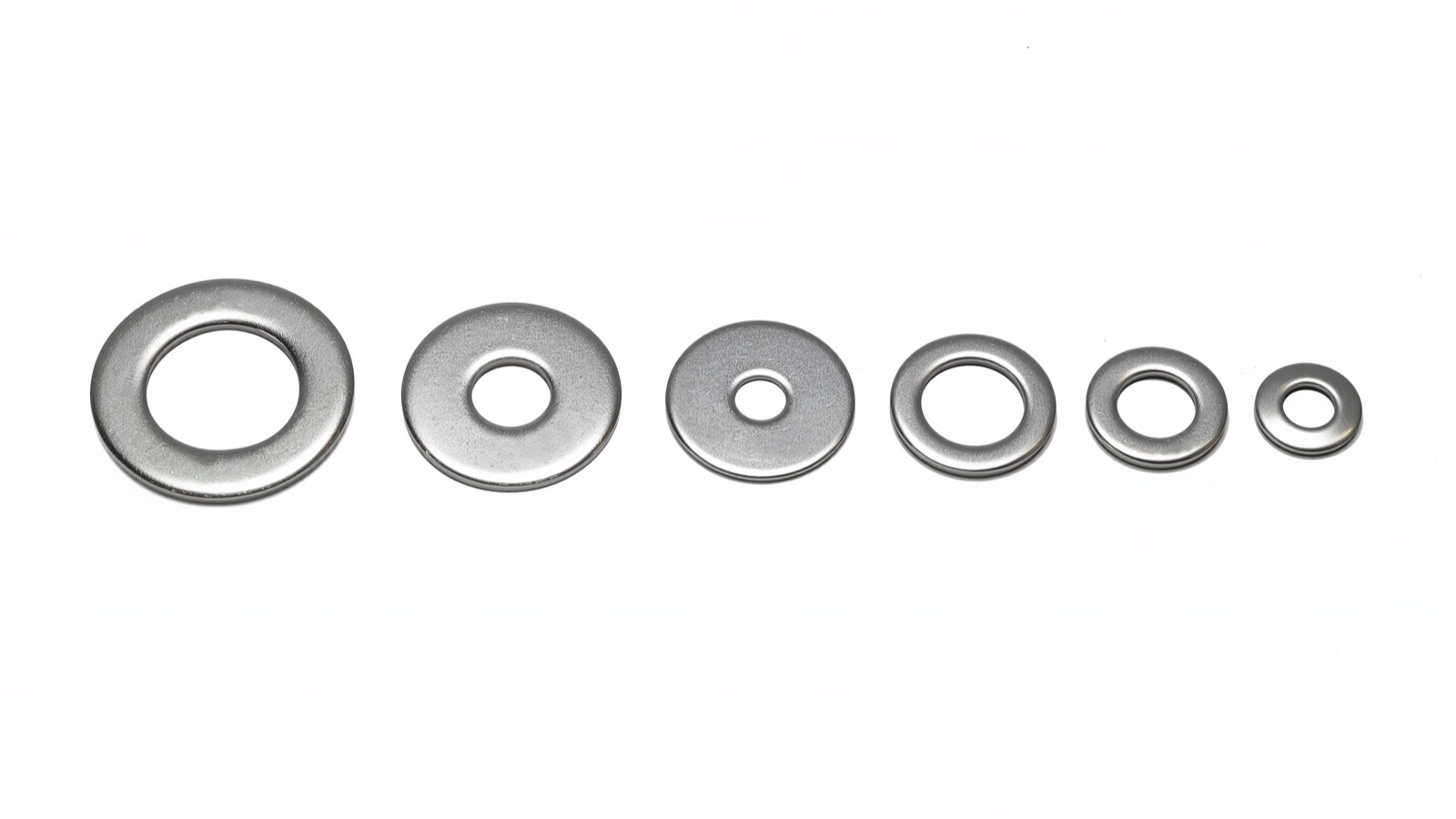
Standards we produce flat washers to.
Tell us the standard and we build to it — metric or imperial, with the matching tolerance class and surface condition. The most common flat-washer standards we run:
DIN 125 — regular
The default general-purpose flat washer. Outside diameter roughly 2–2.5× the bolt; the everyday metric washer for most fastening.
DIN 433 — small OD
A smaller outside diameter than DIN 125, for cheese-head and socket screws or tight bolt-circle layouts where space is limited.
ISO 7089 / 7090
The ISO equivalents of DIN 125 — 7089 plain, 7090 chamfered (200 HV). Dimensionally interchangeable with DIN 125 for most uses.
ASME B18.21.1 Type A
The inch-series plain washer standard for North American assemblies, covering both the narrow (SAE) and wide (USS) pattern series.
USS — wide pattern
The wider inch pattern with a larger outside diameter, for general structural and heavier load-spreading on standard clearance holes.
SAE — narrow pattern
The narrower inch pattern with a tighter outside diameter, common in automotive and machinery where a smaller footprint is preferred.
DIN 125 A flat washer dimensions.
Nominal dimensions in millimetres for the DIN 125 A series. DIN 125 is dimensionally equivalent to ISO 7089 / 7090; the full range runs M1.6–M64.
| Thread d | Inside dia d1 | Outside dia d2 | Thickness s |
|---|---|---|---|
| M3 | 3.2 | 7 | 0.5 |
| M4 | 4.3 | 9 | 0.8 |
| M5 | 5.3 | 10 | 1.0 |
| M6 | 6.4 | 12 | 1.6 |
| M8 | 8.4 | 16 | 1.6 |
| M10 | 10.5 | 20 | 2.0 |
| M12 | 13 | 24 | 2.5 |
| M14 | 15 | 28 | 2.5 |
| M16 | 17 | 30 | 3.0 |
| M18 | 19 | 34 | 3.0 |
| M20 | 21 | 37 | 3.0 |
| M22 | 23 | 39 | 3.0 |
| M24 | 25 | 44 | 4.0 |
| M27 | 28 | 50 | 4.0 |
| M30 | 31 | 56 | 4.0 |
| M33 | 34 | 60 | 5.0 |
| M36 | 37 | 66 | 5.0 |
ASME B18.21.1 Type A — USS & SAE.
Inch-series plain washers in both patterns: SAE (narrow) and USS (wide). All dimensions in inches.
| Bolt | SAE (narrow) | USS (wide) | ||||
|---|---|---|---|---|---|---|
| ID | OD | Thk | ID | OD | Thk | |
| 1/4 | .281 | .625 | .065 | .312 | .734 | .065 |
| 5/16 | .344 | .688 | .065 | .375 | .875 | .083 |
| 3/8 | .406 | .812 | .065 | .438 | 1.000 | .083 |
| 1/2 | .531 | 1.062 | .095 | .562 | 1.375 | .109 |
| 5/8 | .656 | 1.312 | .095 | .688 | 1.750 | .134 |
| 3/4 | .812 | 1.469 | .134 | .812 | 2.000 | .148 |
Flat washer standards at a glance.
Which standard covers your bolt series, what OD pattern it uses, and where to look for more detail.
| Standard | Series | Typical size range | OD pattern | Notes |
|---|---|---|---|---|
| DIN 125 A | Metric | M1.6 – M64 | Regular (~2–2.5× bolt dia.) | Most common metric flat washer; dimensionally equivalent to ISO 7089 (plain) / ISO 7090 (chamfered) |
| DIN 433 | Metric | M1.6 – M20 | Small OD | For cheese-head and socket screws or tight bolt-circle layouts; OD notably smaller than DIN 125 |
| ISO 7089 / 7090 | Metric | M1.6 – M64 | Regular (~2–2.5× bolt dia.) | ISO equivalents of DIN 125 A; 7089 plain, 7090 chamfered; interchangeable dimensions in most uses |
| ASME B18.21.1 Type A | Inch (imperial) | No. 6 – 3 in. | SAE (narrow) or USS (wide) | North American plain washer standard; covers both narrow and wide patterns in one document |
| USS | Inch (imperial) | 1/4 in. – 1-1/2 in. | Wide (large OD) | General structural and heavy load-spreading; wider OD than SAE for the same bolt size |
| SAE | Inch (imperial) | No. 6 – 3 in. | Narrow (small OD) | Automotive and machinery use; tighter OD footprint preferred where clearance is limited |
We also hold references for JIS B 1256, BS 4320, NF E 27-619, KS B 1326 and UNI 6592 — ask if your project calls for these. All standards are produced in 304 (A2), 316 or 316L (A4).
Grades and surfaces, matched to the environment.
We run flat washers in three austenitic stainless grades, with a finish chosen for the corrosion duty and the look you need.
304 — the workhorse
Excellent general corrosion resistance, hygienic and cost-effective. The default for indoor, structural, food-contact and most architectural fastening.
316 & 316L — for the harsh stuff
Added molybdenum for chloride, acid and salt-spray resistance; 316L is the low-carbon variant for welded or sensitised conditions. The grade for marine, chemical and coastal duty.
Bright (as-stamped) as standard, with polished on request — selected for the appearance in play, while corrosion duty is set by the grade (304 vs 316 / 316L). Material certificates (MTC / EN 10204 3.1) available on request.
Where flat washers earn their keep.
The same washer behaves very differently by environment — we match grade, finish and standard to the job.
Construction & Façade
Spreading load on structural and cladding connections exposed to weather.
Marine & Coastal
Salt-spray and immersion duty where chloride attack is constant.
Solar PV & Wind
Outdoor renewable mounting that must last decades unattended.
Food & Hygiene
Wash-down and food-contact equipment needing cleanable surfaces.
Flat washer questions, answered.
The questions distributors and engineers ask us most. Have one we have not covered? Ask our team.
What is the difference between DIN 125 and DIN 9021?
DIN 125 is the regular flat washer, with an outside diameter roughly 2–2.5× the bolt diameter, for general fastening. DIN 9021 is the fender (large-OD) washer, with a much larger outside diameter — typically about 3× the bolt — to spread load over soft, slotted or oversized holes. Same purpose, very different footprint.
304 or 316 for outdoor use?
For sheltered outdoor or general atmospheric use, 304 (A2) is usually sufficient and cost-effective. For coastal, marine, de-iced, chlorinated or chemical exposure, specify 316 / 316L (A4): the added molybdenum gives much better resistance to chloride pitting and salt spray. When in doubt for an aggressive environment, 316 is the safer call.
Can you make non-standard ODs or thicknesses?
Yes. Beyond the DIN and ASME catalogue, we stamp flat washers to your drawing — special outside diameters, inside diameters, thicknesses, chamfers and tolerance classes — in 304, 316 or 316L. Send a print or a sample and we quote to it, with first-article inspection available.
Do you provide material certificates?
Yes. Mill test certificates (MTC, EN 10204 3.1) tracing the melt and chemistry are available on request, and PMI verification can be arranged for export and compliance documentation. Material is sourced from documented melts — genuine, full-spec 304/316/316L stamped to full thickness, not under-gauge or recycled substitutes.
What size range do flat washers cover — metric and imperial?
Metric flat washers run M2–M64 (DIN 125, DIN 433, ISO 7089). Imperial flat washers are produced to ASME B18.21.1 in both SAE (narrow) and USS (wide) patterns, covering standard bolt sizes from 1/4" up. Non-standard sizes outside these ranges can be stamped to drawing — send a print and we quote to it.
Do your flat washers meet ASME B18.21.1, USS and SAE?
Yes. We produce flat washers to ASME B18.21.1 Type A in both SAE (narrow) and USS (wide) patterns in 304, 316 and 316L. Dimensional tolerances are held by high-speed coil-fed stamping — the same automated process used for the DIN metric range. An ISO 9001:2015-certified management system (cert No. 74326Q00174R001) covers inspection and traceability on every production run.
Tell us what you need.
Send specs or a drawing and we will come back with pricing, lead time and material options. No account, no minimum to ask.
- ✓ 304 / 316 / 316L, DIN & ASME or custom
- ✓ Replies from engineers, typically within one business day
- ✓ Samples and material certificates available