
Stainless Steel Spring Washers
Split helical lock washers that resist loosening under vibration and dynamic load. Produced in 304 and 316/316L stainless to DIN 127 — with DIN 7980 (heavy) and GB/T 93 equivalents available on request.
The anti-loosening complement to a flat washer.
A spring lock washer is a single coil of spring-tempered stainless cut into a split ring. Tighten the bolt and the ring is compressed flat; the stored spring force keeps tension in the joint while the sharp ends of the split bite into the bearing surface and the nut face, resisting the rotation that would let the fastener back off.
It is the most widely used, lowest-cost anti-vibration washer in metric assembly — the part buyers reach for when a plain flat washer is not enough but a full wedge-lock system is more than the joint needs. We stamp them in 304 for general and indoor duty and in 316/316L where chloride, salt-spray or chemical exposure is in play.
- DIN 127 Form B is the standard rounded-section split ring; Form A is the older square-edge profile.
- DIN 7980 is the heavy series — a taller section for higher-strength bolted joints.
- GB/T 93 is the equivalent Chinese standard widely specified across Asia-Pacific supply chains.
- Material certificates (MTC / EN 10204 3.1) available on request for export compliance.
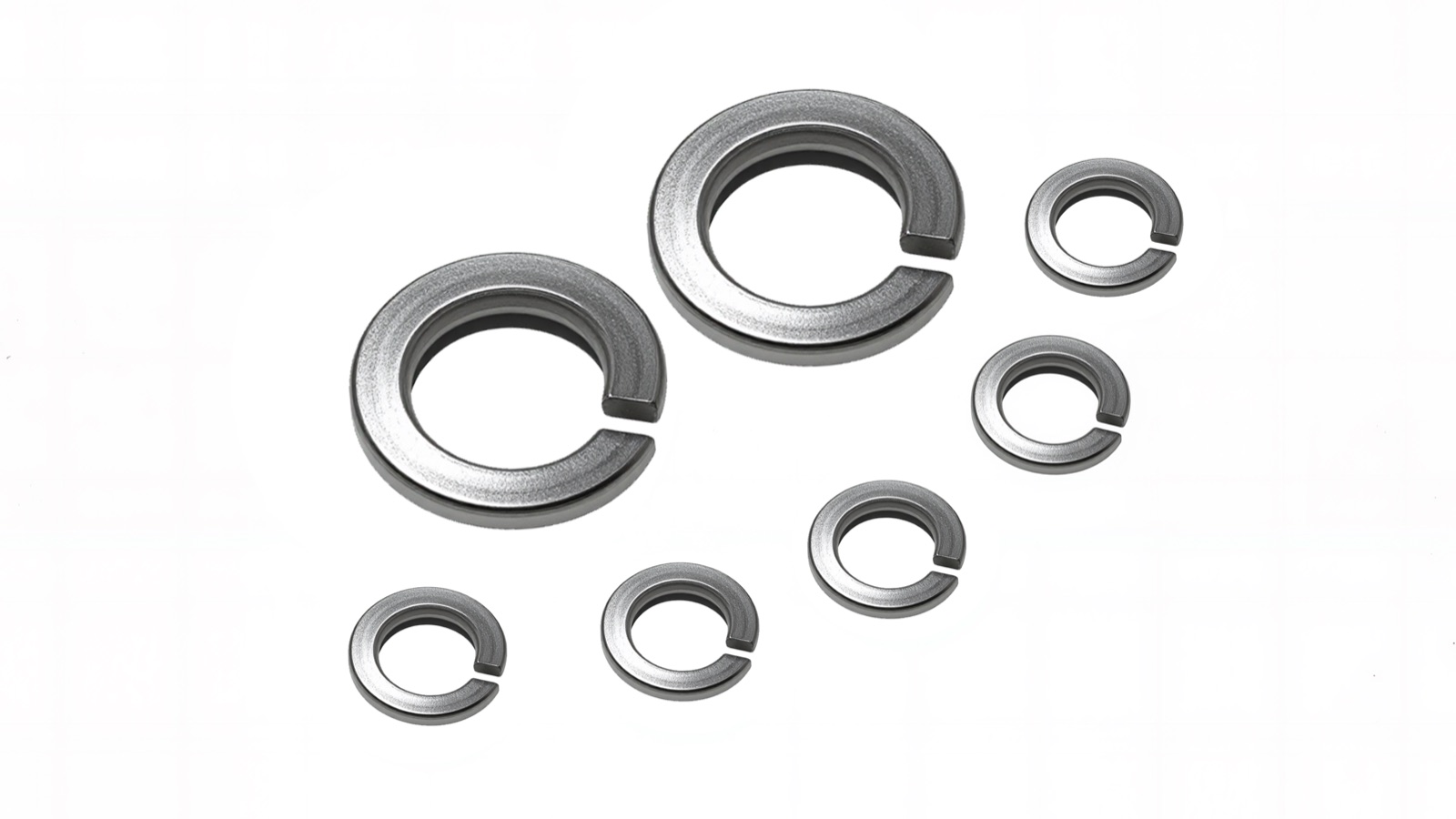
A split ring that springs, then bites.
Two mechanisms act together once the bolt is torqued down: stored spring tension and a mechanical bite into the joint surfaces.
Axial spring tension
Tightening flattens the helical ring. The compressed coil pushes back along the bolt axis, maintaining clamp tension and taking up the small relaxation that lets joints loosen.
The split bites in
The two sharp edges of the gap dig into the nut face and the workpiece. Any tendency for the nut to rotate loose drives those edges further in, opposing back-off like a one-way ratchet.
Best with dynamic load
The effect matters most where the joint sees vibration, thermal cycling or repeated shock — machinery, rolling stock and vehicle assembly — rather than static structural connections.
DIN 127 Form B — representative sizes.
Split spring lock washer, Form B (rounded section). For Form B the section width and thickness are equal (b = s). Dimensions in millimetres; values are typical per DIN 127B.
| Thread size | Inside dia d1 (mm) | Section b = s (mm) |
|---|---|---|
| M3 | 3.1 | 0.8 |
| M4 | 4.1 | 0.9 |
| M5 | 5.1 | 1.2 |
| M6 | 6.1 | 1.6 |
| M8 | 8.1 | 2.0 |
| M10 | 10.2 | 2.2 |
| M12 | 12.2 | 2.5 |
| M14 | 14.2 | 3.0 |
| M16 | 16.2 | 3.5 |
| M20 | 20.2 | 4.0 |
| M24 | 24.5 | 5.0 |
Right joint, right washer.
Spring washers earn their place in vibrating, dynamically loaded joints. Knowing where they shine — and where a different solution is wiser — keeps assemblies reliable.
Automotive
Chassis, brackets and accessory mounting subject to constant road vibration and shock.
Rail & Rolling Stock
Bogies, equipment frames and track-side fixtures where dynamic load never lets up.
Machinery & Equipment
Pumps, motors, gearboxes and rotating plant where bolted joints see continuous oscillation.
Split spring washers are proven and economical, but research shows their effect is limited under severe transverse (Junker) vibration. For critical joints they are often paired with a flat washer to protect the surface, or replaced by prevailing-torque nuts, thread adhesive, or tooth-lock / wedge-lock washer systems. Tell us the load case and we will recommend the right approach.
Grade and finish matched to the environment.
Spring washers must hold their temper and resist corrosion in the joint. We stamp from spring-quality stainless and finish to suit the application.
304 — general & indoor duty
Strong general corrosion resistance at a sensible cost. The default for machinery, automotive interiors, general assembly and most indoor or sheltered structural joints.
- Machinery & equipment frames
- Automotive & general industrial
- Indoor and sheltered fastening
316 / 316L — harsh & corrosive
Added molybdenum for chloride, salt-spray and chemical resistance. Specified where the joint is exposed to marine, coastal, chemical or wash-down conditions.
- Marine, offshore & coastal
- Chemical & petrochemical plant
- Outdoor and wash-down equipment
Bright finish
Standard as-stamped bright finish — the natural surface of spring-quality stainless straight from forming.
Polished
Mechanically polished, higher-lustre finish on request for hygiene or appearance; step up to 316/316L where extra corrosion margin is needed.
Certified material
Mill test certificates (MTC / EN 10204 3.1) and PMI available on request for traceability and export compliance.
Spring washer questions, answered.
What is the difference between a spring washer and a tooth washer?
A spring (split-ring) washer is a single helical coil that works as a spring: when compressed it stores axial tension and its sharp split ends bite into the nut and the surface to resist back-off. A tooth (serrated) lock washer instead has many small teeth around its circumference that dig into both bearing faces, giving more bite points and useful electrical bonding. Spring washers suit larger bolts and coarse joints; tooth washers suit thin sheet, panels and grounding applications.
Do spring lock washers really prevent bolts from loosening?
They help, but they are not a cure-all. A DIN 127 spring washer keeps some tension in the joint and resists slow loosening, and it is a long-proven, low-cost choice for moderate vibration. Under severe transverse (Junker) vibration its effect is limited, so for critical dynamic joints many engineers pair it with a flat washer, use a prevailing-torque nut, add thread adhesive, or step up to a wedge-lock / tooth-lock washer system. We can supply spring washers or recommend an alternative for your load case.
What sizes of stainless spring washers do you supply?
We produce DIN 127 Form B spring washers across the common metric range — roughly M3 to M24 and beyond — in 304 and 316/316L stainless. The table above lists representative sizes; the full range per the standard is available on request, and we also make non-standard section widths and inside diameters to drawing.
Which standard do your split-ring spring (lock) washers follow — DIN 127 or another?
Standard production is DIN 127 Form B (rounded helical section). DIN 7980 (heavy series, taller section for higher-strength joints) and GB/T 93 are also available. Other references — JIS, BS, NF, KS, UNI — or made-to-drawing dimensions on request. Parts are stamped on high-speed automated coil-fed presses from spring-quality 304 or 316/316L coil, so dimensional consistency across a production run is not a guessing game.
Are stainless steel spring washers suitable for corrosion-exposed or all-stainless assemblies?
Yes. 304 (A2) covers most machinery, automotive and indoor applications. 316/316L (A4) adds molybdenum for chloride, salt-spray, marine and chemical-plant environments. Both grades are stamped from genuine full-specification stainless coil — documented melts, full thickness, no under-gauge or recycled substitution — so corrosion resistance matches what the grade specification states. See 304 vs 316 stainless for a grade comparison.
Can you make spring washers to a custom drawing or sample, and do you supply material certificates?
Yes to both. We stamp to customer drawings or samples — special IDs, ODs, section widths, thicknesses and non-circular holes in 304, 316 or 316L. Custom parts go through first-article inspection before bulk production. Mill test certificates (MTC / EN 10204 3.1) and PMI are available on request; our ISO 9001:2015 process (cert. No. 74326Q00174R001) keeps the material trail documented. MOQ and lead time are confirmed with your quote — send us the drawing and we will reply within about one business day.
Tell us what you need.
Send specs or a drawing and we will come back with pricing, lead time and material options. No account, no minimum to ask.
- ✓ 304 / 316 / 316L, DIN & ASME or custom
- ✓ Replies from engineers, typically within one business day
- ✓ Samples and material certificates available